Dormant in Paradise: Why Sleeping Giants USC and UCLA Can’t Seem to Put It Together, and What Will Happen When They Finally Do
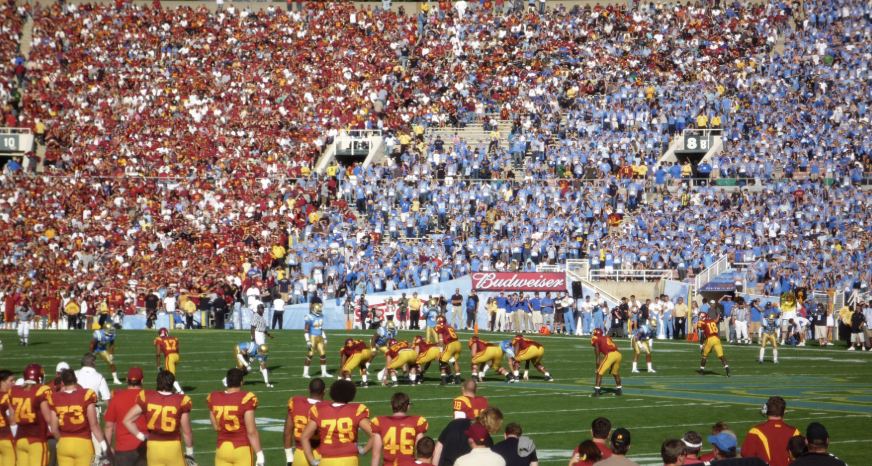
Los Angeles is a city built on stars, and for nearly a century, two of its brightest have been the athletic departments of the University of Southern California (USC) and the University of California at Los Angeles (UCLA). Together, they represent a historical concentration of collegiate athletic success rivaled only by a handful other American metropolises. UCLA boasts the second-most NCAA Division I team championships in the nation, with USC trailing just behind in third.
This legacy is built on distinct pillars of dominance. USC has long been a titan of the gridiron, a blue-blood program with 11 claimed national championships, more Heisman Trophy winners (8) than any other school, and an immense NFL pipeline. UCLA, conversely, is collegiate basketball royalty. The program is synonymous with the dynasty built by legendary coach John Wooden, a period of dominance that established the Bruins as a perennial power.
For decades, the school's athletic competitions served as the ultimate barometer of West Coast athletic supremacy. The two schools have been conference mates since 1928, and the annual football game has often been a high-stakes affair, with the winner frequently claiming or sharing the conference title. The rivalry has been defined by ebbs and flows, with UCLA enjoying an eight-game winning streak in the 1990s before USC, under Head Coach Pete Carroll, began a dominant run in the 2000s. This history of excellence has forged a standard which both programs have recently failed to measure up to.
While both USC and UCLA have fallen short of their historical standards, their paths to mediocrity have been starkly different. USC's struggles are rooted in a crisis of culture and identity, while UCLA's are the product of systemic financial mismanagement and a unique set of market challenges.
The Fading of Dominance
The beginning of USC's modern decline can be traced directly to the departure of Head Football Coach Pete Carroll for the NFL after the 2009 season. Carroll was more than a coach; he was a unifying force who established a culture of swagger and relentless competition that defined the program. In the years since, the university has failed to replace that cultural foundation. The program has cycled through five head coaches in 15 years, creating a culture of constant flux and preventing the establishment of a consistent identity.
This coaching turmoil has been mirrored by instability in the athletic director's office. Mike Garrett was ousted in 2010 following severe NCAA sanctions. He was succeeded by Pat Haden, then Lynn Swann, and most recently Jennifer Cohen, who was hired in 2023. This administrative carousel has prevented the implementation of a coherent long-term vision. The department's reputation was further damaged by the 2019 college admissions bribery scandal, which implicated a senior associate athletic director and a legendary water polo coach.
The hiring of Lincoln Riley from Oklahoma was a massive financial and symbolic investment intended to instantly restore USC's offensive firepower and national relevance. After an 11-3 record and a Heisman Trophy for quarterback Caleb Williams in his first season, the promise seemed fulfilled. However, the team's record has progressively worsened since, falling to 8-5 in 2023 and 7-6 in 2024. Riley's tenure has exposed the program's deeper issues: elite offensive coaching has not been enough to overcome a persistent lack of discipline and a porous defense. In response, the program has recently brought in new assistant coaches tasked with increased standards and correcting a lax culture that has reportedly permeated the program since the Carroll era. USC's problem is not a lack of resources or talent, but a decade-long failure to build a stable culture.
UCLA's underperformance stems from a different, though no less debilitating, set of problems: a staggering financial crisis and a profound disconnect with its own market. The athletic department has been hemorrhaging money for years, accruing a staggering $219 million deficit over a six-year period, including an $80 million shortfall in 2024 alone. The financial situation became so dire that Athletic Director Martin Jarmond admitted that without a massive new revenue stream, preserving all 25 of UCLA's varsity sports was not a guarantee. This mismanagement has been attributed to costly decisions, such as contract buyouts for underperforming coaches and questionable expenditures under said coaches.
Bruins' donors have criticized a flawed and misunderstood Name, Image, and Likeness (NIL) strategy, continued high spending in the face of massive deficits, and a failure to hold coaches accountable for subpar results. The discontent has boiled over into open revolt, with fans planning "Fire Jarmond" protests and prominent donors threatening to rescind their financial support.
UCLA's financial woes and on-field mediocrity are caught in a vicious cycle with fan apathy. Operating in the saturated Los Angeles entertainment market, the university's teams struggle for attention against a dozen professional sports franchises. Unlike in a traditional college town where the university is the main attraction, UCLA football and basketball games are often an afterthought. This results in chronically low attendance, with the football team failing to fill even 60,000 seats for the rivalry game against USC in 2018. The only exception is the presence of a star player, such as Lonzo Ball, whose 2017 season led to multiple sellouts. This apathy, rooted in an LA culture that prioritizes pro sports, leads to lower ticket and merchandise revenue. Exacerbating the budget deficit. The resulting financial constraints limit the department's ability to invest in the facilities and coaching required to build a winning program.
The Big Ten Gamble: Huge Potential with Hidden Costs
Facing these deep-seated institutional problems, both universities made a seismic decision in June 2022: they would leave their long time home in the Pac-12 Conference and join the Big Ten in 2024. At its core, the move was a financial imperative. The Pac-12's media rights deal was lagging far behind its competitors, distributing only $19.8 million to each member in fiscal year 2021, a fraction of the $46.1 million distributed by the Big Ten and the $54.6 million by the SEC. With the Big Ten's new media rights deal projected to deliver upwards of $80 million to $100 million annually per school, the move was an economic necessity. For debt-ridden UCLA, it was a lifeline secure its entire athletic department. For USC, it was a strategic decision to ensure stability in a rapidly changing landscape.
However, this billion-dollar lifeline comes with significant hidden costs. The creation of a coast-to-coast conference has shattered over a century of regional tradition, ending historic rivalries with West Coast peers like Stanford and California. More pressingly, it places an enormous burden on the student-athletes themselves. The move exponentially increases travel demands, forcing athletes in all sports to endure cross-country flights across multiple time zones. This will inevitably lead to more missed class time and an increase in physical and mental fatigue, further straining the already tenuous concept of the student-athlete.
The recruiting landscape has also been altered. While the move provides a larger national platform and the prestige of the Big Ten, it also presents a new challenge. West Coast recruits and their families, who were once able to travel to most away games within the Pac-12, now face a far more difficult and expensive travel schedule. The move to a national conference has created a new arms race, where success is determined not just by dominating local recruiting but by building a brand that can attract elite talent across the country. Early signs suggest USC is adapting quickly, leveraging its new status to build the nation's No. 1 recruiting class for 2026, while UCLA's donor complaints about a flawed NIL strategy suggest they may be falling behind in this national competition.
Ultimately, the move to the Big Ten is a massive financial solution applied to problems that are not solely financial. For UCLA, the influx of cash may resolve the immediate budget crisis, but it does not inherently fix the alleged administrative dysfunction. For USC, more money does not automatically instill the discipline and defensive identity that has been missing for over a decade. The move is a high-stakes gamble that the new resources will enable the schools' leadership to finally address their core weaknesses, with no guarantee of success.
A Forecast for the Future
As the two Los Angeles schools navigate their new conference, the path back to national prominence is both clearer and more challenging. The expansion of the College Football Playoff, paired with a proposed format that would grant multiple automatic qualifying spots to the Big Ten and SEC, provides a potential route to championship contention. If USC or UCLA can consistently finish near the top of the Big Ten, they will have a seat at the table.
Immediate on-field expectations, however, are tempered. After a rocky 7-6 debut in the Big Ten, analysts project a wide range of outcomes for USC. UCLA, meanwhile, faces questions surrounding their Head Coaching vacancy, and quarterback Nico Ieamaleava.
The Big Ten move provides the opportunity and the resources for a renaissance, but it does not guarantee one. Success will hinge on whether each institution can finally confront the issues that have kept them dormant. For USC, this means building a stable, disciplined culture that extends beyond a high-powered offense. For UCLA, it means overcoming deep-seated administrative and financial issues to prove it is truly committed to competing at the highest level. There are paths for each athletic department to right the ship, but it remains to be seen whether they will be able to do so.